
Crypto Funding Rates Explained: The Fee That Quietly Eats Your Profit
Funding is the recurring fee almost no beginner accounts for — and on a position you hold for days, it can outweigh your trading edge. Here's how it works, in plain numbers.
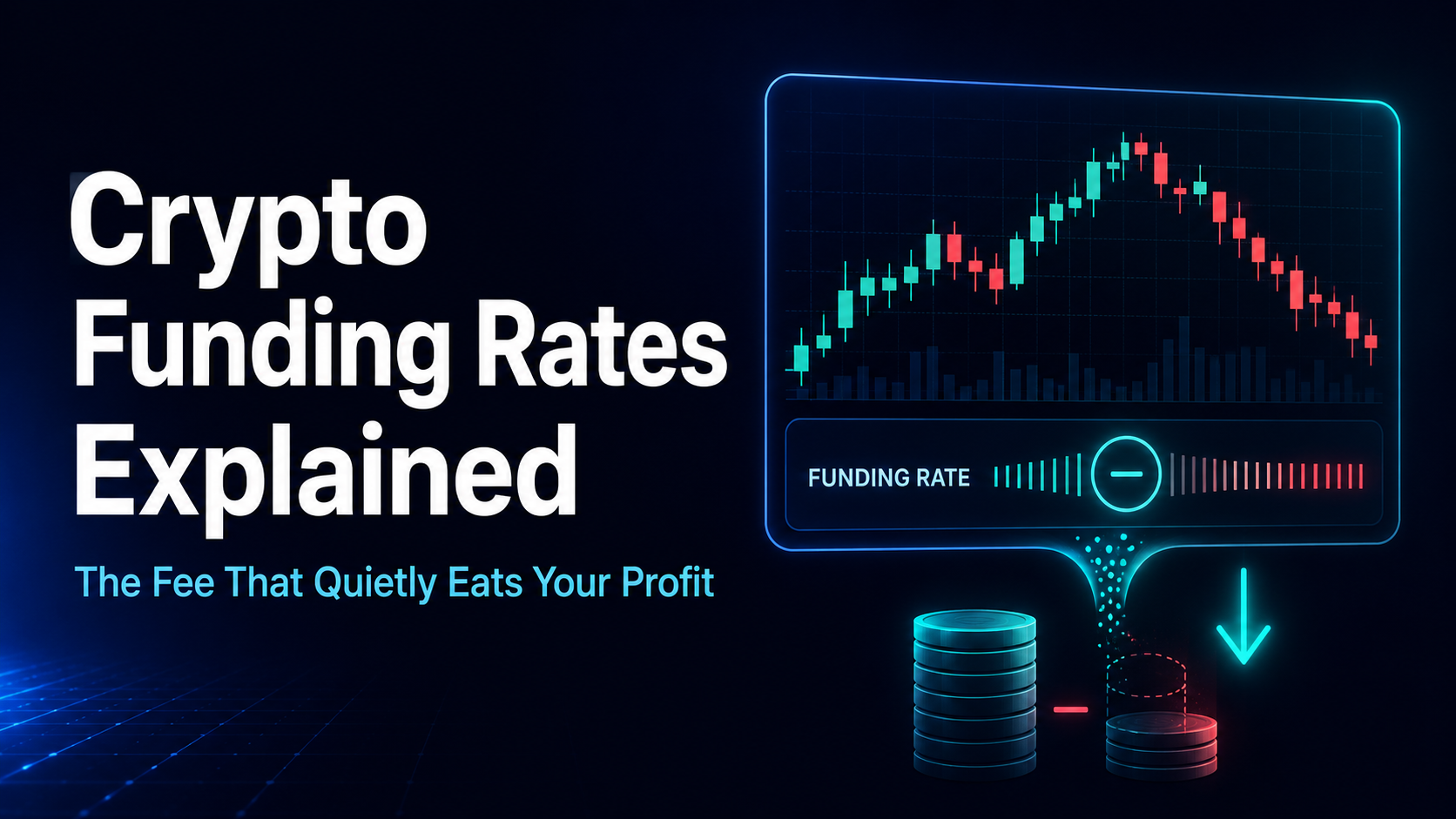
If you trade perpetual futures and you've never thought about funding rates, you're paying a fee you can't see. It's small per charge, it's invisible on the order ticket, and on a position you hold for a few days it can quietly cancel out a winning trade. This post explains exactly what funding is, how it's calculated, and how to stop overpaying — with real numbers, not hand-waving.
Why funding exists at all
A perpetual swap ("perp") is a futures contract with no expiry date. That's the feature everyone loves and the reason funding has to exist. A normal futures contract is tethered to spot price because it settles on a fixed date. A perp never settles, so the exchange needs another mechanism to keep the perp price glued to the real spot price. That mechanism is the funding rate.
Funding is a periodic payment exchanged directly between traders — longs and shorts — not a fee the exchange pockets. The rule is simple:
- Funding positive (the usual state in a bull market): longs pay shorts.
- Funding negative: shorts pay longs.
When too many people are long and the perp trades above spot, positive funding makes holding a long expensive — which nudges the price back down toward spot. It's a self-correcting tether, paid for by whoever is on the crowded side.
How it's actually charged
Three things decide what you pay:
- The rate — usually small. A typical baseline on Binance is around 0.01% per 8-hour window (charged at 00:00, 08:00 and 16:00 UTC). That's ~0.03%/day, roughly 11%/year. In euphoric markets it can spike to 0.05–0.1%+ per window.
- Your position's notional size — funding is charged on the full position value (mark price × size), not on your margin.
- Whether you're holding at the timestamp — you only pay (or receive) if your position is open at the funding moment. Open and close between windows and you pay zero funding.
Funding payment = funding rate × position notional
(charged only if you hold the position at the funding timestamp)
The numbers that surprise people
Take a $10,000 long position, baseline funding of 0.01% per 8h:
Per 8h window : $10,000 × 0.0001 = $1.00
Per day (×3)  : $3.00
Per month     : ~$90   (0.9% of the position, every month)
Annoying, not fatal. Now hold the same position through a hot, crowded market where funding runs at 0.1% per window:
Per 8h window : $10,000 × 0.001 = $10.00
Per day       : $30.00
Per month     : ~$900   (9% of the position — every month)
That's no longer a rounding error. That's a headwind big enough to turn a correct directional call into a losing trade if you sit in it too long.
Why leverage makes it worse
Here's the part that catches people out. Funding is charged on notional, but your risk capital is your margin. With 10x leverage, that $10,000 position is backed by only $1,000 of your money. So at baseline funding:
$90/month funding ÷ $1,000 margin = 9% of YOUR capital per monthAt elevated funding it's ~90% of your margin per month. The higher your leverage, the larger funding looms relative to the money you actually put up. (If leverage itself is fuzzy, start with Crypto Leverage Explained, and size your downside with the liquidation calculator.)
Funding as a signal, not just a cost
High positive funding isn't only expensive — it's information. It means the market is lopsidedly long, which is exactly the setup that precedes a long squeeze. Persistently extreme funding is a crowding warning, not a green light. Smart traders read it both ways: as a cost to manage and as a sentiment gauge.
How to stop overpaying
- Don't marry a leveraged position through dozens of funding windows. Time in the trade is funding paid. A held leveraged long in a high-funding regime bleeds whether or not you're right.
- Check the current funding rate before you enter a position you plan to hold. It's published on every major exchange.
- Prefer setups with a defined exit over open-ended "hold and hope." A trade with a target and a time limit caps your funding exposure by design.
- Be wary of the crowded side. If funding is screaming positive, being long is both expensive and risky.
Where this fits with Ezath
Funding is one more reason the exit matters as much as the entry. Every Ezath signal on BTC, ETH and SOL ships with exact levels and a defined plan, and the optional Auto-Trader closes positions on its own rules — including a hard time-stop — so a trade can't sit open bleeding funding indefinitely. And because every call is resolved against live Binance candles on a public track record, the performance you see is the performance after the market does its thing. Start on the free plan (no card) and watch how defined exits keep the slow costs in check, or read How to Trade Crypto Futures on Binance for the full mechanics.